Ultimate Email Marketing Guide [2025]
Marketing Digital ·
Learn here all the points related to developing Email Marketing strategies, to optimize your campaigns and achieve the sales you desire.
Introduction
Email Marketing is any communication made via email between a company and its contacts (or clients). An Email Marketing campaign can be developed in text or HTML and can contain products, promotions, content, etc. Generally, messages are sent using an email sending tool.
In this special guide, we will cover all points related to developing strategies in this channel, to optimize your campaigns and achieve the results you desire.
Happy reading!
One of the communication channels that is yielding the best results, thanks to its high profitability, is emailing.
What is Email Marketing?
Just as every good restaurant must have a great waiter, every company can and should have a good relationship with its contacts, whether they are future sales or current customers. Many of the companies we help grow here at Evox already had good Email Marketing relationship practices.
Considering that according to the website Statista, the number of email users worldwide will be nearly 3 billion in 2019 — more than a third of the population. It is likely that your company's target audience is among those people, right?
The history of Email Marketing began in the late 1970s when Digital Equipment Corp's marketing manager, Gary Thuerk, sent 400 emails promoting the company's computers, resulting in $13 million in sales.
But it was in the 1990s that the internet massified Email Marketing. This opened the doors to a new form of communication, but also gave rise to unwanted spam, as well as rules to protect consumers from that practice.
In the 2000s, it became evident that thinking only about sending email messages, without considering the recipient or the content, was not enough. Since then, it is understood that to do effective Email Marketing and not end up in the spam folder, it is important to follow good practices.
The emergence of technologies like smartphones and new forms of relationship, such as social media, also had an impact on Email Marketing. However, regardless of technology, it is known that today it is important to focus on the needs of each user when receiving the email.
Thus, what started as mass communication developed into a relationship strategy with Leads and customers. Currently, marketing automation systems allow advanced segmentation and analysis of sent messages with a strategic focus on Email Marketing.
Advantages of Email Marketing
Many people once said that Email Marketing was nearing its end with the growth of social media, but that was not the case.
This is because people have fully incorporated email into their lives: it is the simplest and most fundamental thing someone can have on the internet. Many go further and are even compulsive in their use, spending all the time with their inbox open and checking every new message that arrives.
Undoubtedly, social media is a great way to spread your message and reach your customers. However, these channels are generally seen with more informality and less commitment than email. People do not feel obliged to see every post on the Facebook page of the companies they follow, nor read every post published on their favorite brands' blogs. Additionally, it is more difficult to keep up with all the updates posted on social media.
Emails are carefully looked at, usually every day. Although we all have to deal with some unwanted spam, if the person has signed up for your company's content and knows it is relevant to them, there is a very high tendency that your email will be opened and read.
Therefore, using Email Marketing correctly is a very efficient weapon to maintain a relationship with people, whether they are current customers or potential prospects. This is an asset that must be nurtured over time and exploited with care, but the results are worth the effort.
- Approximately 80% of marketers noticed an increase in email interactions in the last 12 months. (HubSpot, 2020)
- In 2019, the number of global email users was 3.9 billion. (Statista, 2019)
- It is estimated that by 2024, the number of global email users will be 4.48 billion. (Statista, 2019)
- In a study with 1,000 small business owners, email marketing was ranked as the second most effective medium for generating brand awareness. (Campaign Monitor, 2019)
- Email marketing generates the highest return on investment for small businesses. (Campaign Monitor, 2019)
- The highest open and unsubscribe rates occur on Tuesdays. (Campaign Monitor, 2019)
- The average email delivery rate across all service providers is 79.6%. (EmailToolTester, 2019)
- In the US, 21% of email opens occur between 9 am and noon. (Litmus, 2019)
Types of Email Marketing
Email Marketing is a communication and relationship channel that offers various strategy options for Digital Marketing. With it, it is possible to use various communication formats, such as offers, newsletters, activations, greeting cards, useful notices, etc.
Each of these formats should be used for specific occasions. Some are more geared towards selling a product, notifications about a blog update, offering a free download, commemorations, among others.
Below, we will explain a bit more about some of these formats so that you have an overview of what can – and should not – be done.
Newsletter
The newsletter is a good way to communicate to nurture the relationship with your Leads and customers in a lighter and closer manner.
These usually have a broader coverage of interests, addressing various topics within a broad theme. For example, it is possible to promote a product to those at an advanced stage of purchase, but also be relevant to those who are still only interested in articles and tips. If your company already has a blog with frequent content, the newsletter is an excellent way to leverage the reach of that content.
Promotional Email
First of all, it is important to understand that "promotional" does not only mean an email promoting offers and products. The case of the "promotional" email refers to "promoting an offer," whether it is free content or an actual product.
To be more precise, a promotional email can be:
- Physical products (like e-commerce and retail companies in general).
- Digital products/services (such as consulting offers, software, and paid tools).
- Free digital products (such as eBooks, tools, webinars, etc.).
Promotional emails focus solely on conversion, without the various options that a newsletter has. They have an enormous potential to deliver the right message to the right person at any stage of the buying journey, if done in an optimized way.
And how to do them in an optimized way? The secret lies in segmentation, i.e., sending the email to a specific target audience that is interested in what is being offered.
On this page, in the "Segmentation" section, you will learn how to target a list to get better results.
Seasonal Email
Another option for using Email Marketing is to take advantage of each user's special dates to send a personalized message.
These campaigns can correspond to birthday messages, commemorative dates, congratulations on some achievement, and celebrations in general. The central idea is to make your Leads and customers feel remembered and that your company is present at important moments for your audience.
Commemorative dates can be excellent for promoting your brand. Generally, seasonal emails involve greater use of visual elements and short texts to capture and maintain the recipient's attention.
Welcome Email Marketing
The welcome email is the email you will send to your prospect as soon as they become a Lead. It may not seem important, but this email has several functions, mainly to advance the user in your buying journey, i.e., nurture them with relevant information. The next step they take can be decisive in the relationship with your company.
At Evox, we conducted an experiment to test the impact of this email. We wanted to know the return rate of users across all channels. That is, how many of the users who had just entered our base ended up returning. The answer was: 31% of people returned.
So, we decided to send this email. After doing so, the rate became 47.6% return for new users (a 51% increase in this metric, which is one of the most important for any business).
Email for Inactive Clients
To increase the engagement rate of your campaigns and achieve the goal that originated the send, rule number 1 for emails to inactive clients is to make an interesting offer, aligned with the characteristics of the audience that will receive the email and with an appropriate frequency.
It is also important to remember the relevance of your email subject line and to target the selected Leads for the send, among other important tips for your email campaigns to have good open and click rates.
Additionally, there are some good practices you can adopt to engage your Leads who no longer interact with your emails. These are:
- Ask what content they would like to receive.
- Make targeted ads to your Leads on social media (use their email to find them).
- Avoid using group emails (like finance@ or contact@).
- Notify the Lead that they will not receive spam or include the opt-in option (this will help prevent registration with temporary emails).
- Confirm the Lead's subscription.
- Clean your email list.
Email for Ecommerce
Email Marketing plays a very important role for companies that work in the e-commerce model, whether to engage, build relationships, increase conversion rate, send promotions, announce new products, or reduce the number of abandoned carts.
Below are some tips for this tool to give you the best results and for the messages to be relevant and not go to spam.
- Create ways to encourage customer registration on your mailing list. This ensures a base of genuinely interested people. This is the first step for effective campaigns and messages that are not considered spam. Include some registration fields to identify the profile of the participants in your mailing and send the right message to your customers.
- Send what is relevant to your customer and has a connection with the store, such as promotions, launches, and other information linked to the store, but also connected to your business and that helps the consumer solve some type of problem.
- Test various possibilities of email subject, content, layout, time, and frequency of sending – then evaluate and adopt those that generate the most results.
Email Automation
Marketing Automation is any interaction that occurs between the company and the Lead/client in an automated way, with the aim of relating to them according to their actions on your website, social media, or Email Marketing.
This means that, depending on the path your Lead or client takes, your response to them will be different. In other words, the relationship, although automated, will be personalized.
Therefore, Email Marketing Automation consists of sending automatic emails to the Lead, depending on a specific action they performed. These emails can be of various types, but here we will focus on Lead nurturing emails, which consists of automatically sending a series of emails with content related to the topic the user showed interest in.
As the email messages are sent and the Lead consumes the content, new messages are sent, guiding the user through the buying journey until they reach the Bottom of the Funnel. If they reach this stage, it is a sign that they are probably ready to buy and, if qualified, it is the ideal time for the salesperson to approach them.
These emails will help you inform the Lead as they become aware of the importance of your solution, increasing the chances of them buying from you.
Email Marketing Tools
If your company is starting out in Digital Marketing, you may have encountered some difficulties in sending emails at scale or managing an extensive contact list. An Email Marketing software comes in here to solve this difficulty.
Some actions you can do with an Email Marketing software:
- Segment your contacts: to have total control over the audience that will receive your emails.
- Create efficient layouts: to help in designing your emails and create reusable templates.
- Automate the launch of your campaigns: to gain productivity and efficiency in sending emails.
- Track the performance of launches: to see how many opens and clicks your campaigns had, among other statistics.
Before choosing a tool, the two main questions the company must ask at this point are "What is my goal with Email Marketing?" and "What features does your company really need to achieve these goals?"
Below, we show you the 4 main points a company should observe when looking for the ideal Email Marketing software.
How to Choose an Email Marketing Software
1. Does the software/company have a good reputation in the market?
The first step is to know the reputation of this Email Marketing software.
This point is important because it will determine whether the company has good support, whether the tool is easy to use, whether delivery and campaign reporting are good, among others.
Talk to a seller from this company, or through some support channel, ask about the reputation of this tool's IP address and, if possible, confirm it at SenderScore.org, a service that monitors and evaluates the sending reputation of various IPs.
2. How is the integration with Landing Page and CRM services?
It is essential that the tool has integration with others that are also fundamental to the Inbound strategy, such as Landing Pages, CRM, and Analytics.
There are two main objectives for these integrations:
- Avoid loss of information and consequent poor segmentation: For example, sending product campaigns to someone who is already a client and software updates to someone who is not yet a client;
- Get more intelligence about Leads: In addition to the materials that person downloaded, which email campaigns and automation flows they participated in, engaged with, etc. When we think about sales, this type of information is very important to help in approaching potential clients.
If your company already uses a CRM or some service for Lead capture pages, it is important to ensure that the Email Marketing software has this integration.
Another option is to use "horizontal" Digital Marketing software, which has all these tools (Email Marketing, Landing Pages, and CRM) already integrated with each other and with third parties.
3. Are lists static or dynamic?
To segment a Lead base before sending a campaign, it is normal to work with lists, whether static or dynamic lists.
In static lists, Leads must be added and updated manually before each send.
And in dynamic lists, the software will do this filtering for you based on various information, such as the Lead's job title, their buying stage, the market segment they operate in, or even their topic of interest.
In addition to automatic segmentation, with dynamic lists, the company also saves time by not needing to worry about manually updating the lists before each campaign send.
4. Does the software have marketing automation features?
It is important to evaluate from the start whether the chosen Email Marketing software also has Automation functionality, whether simpler, with Autoresponders, or more advanced, with Workflows, for example.
Checklist: important points
Below, some points your company should observe when evaluating an Email Marketing software:
- Does it have good IP reputation?
- Does it have success stories?
- Does it integrate with your company's CRM?
- Does it integrate with the Landing Page service your company uses?
- Does the tool provide information on open rate, click rate, unsubscribes, bounces, and click map?
- Does it allow segmentation of the Lead base based on this information?
- Does it allow creating automation flows based on these interactions with an email campaign?
- Does it have merge tags – ability to use personalized information in the text, such as the Lead's name?
- Is support good? If you have any doubts about the tool or about some concept of Digital Marketing, can you count on subject matter experts?
- Does it provide ready-made templates, needing only to change images or text?
- Does it accept import of contacts your company already has?
- Does it report invalid contacts (unsubscribes and invalid emails) for list cleaning?
- Does it have a history for each contact, to know which campaigns a given Lead received, opened, and clicked, as well as which Landing Pages they converted on?
- Does it have Marketing Automation?
Regardless of the chosen Email Marketing software, during the evaluation it is always important to do a trial period to check all these points and see if your company adapts to the tool.
Database Cleaning Tools
When some time passes without sending email messages to your lists or migrating from one tool to another, it is important to perform a contact list cleaning (also known as database hygiene) to remove invalid emails.
This action is important to ensure that future campaigns do not have high rates of negative results, such as hard bounces.
Since it is impractical to do this cleaning manually, there are various paid tools that perform this service automatically. Know the 3 main ones:
Tools to Evaluate Deliverability
The main way to understand if your email strategy makes sense and if your emails are delivered to the user's inbox is by using tools to streamline this process. The main ones are:
Tool to Evaluate Email Quality
It is very important that, after a campaign is planned and executed, it is tested and evaluated before launch. This way, errors are reduced and the chances of your campaign looking good increase dramatically.
For that, we use the following tool:
How to Plan and Execute Email Marketing Campaigns
When planning an Email Marketing strategy, you need to keep in mind the following points: audience planning, launch frequency, template creation, and segmentation. See more about each of them:
1. Audience planning:
Understanding your audience, having the right tools and structure, it is important that you understand the strategy.
For that, it is extremely important to know how to answer the following questions:
1.1. Who is your audience?
In this planning stage, you will analyze who your target audience is, with whom you will communicate.
To plan your audience assertively and save time, you must define your company's ideal customer profile, so that you can optimize the process of creating personas and learn how to define your target audience.
1.2. What actions do you intend to perform with your Email Marketing?
To answer this question, you need to establish an objective. It is a question that only you can answer: is it to sell, inform, educate, download materials, generate leads?
With this focus, you establish a plan, prioritize your actions based on the objective, and generate more results for your business.
1.3. What is your company's tone of voice?
Is it informal, like a surfboard store, or extremely formal, like a law firm?
Establish a standard tone for your company and maintain it. This tone can be based on your buyer persona, even. It is a great way to generate empathy via email, in addition to standardizing the expectations of the people who read your emails.
1.4. What do you consider success for your email?
Success, in this case, is considered: "given my established objective, how much am I achieving?". For example:
- Sell 10 accounts.
- Generate 20 new leads.
- Educate 10 Leads.
- App download.
It is basically your goal and how close you are to it. It is important to have this context defined, as it will motivate your actions and the planning of your emails.
2. Creating a Template
Now, with a well-defined strategy, the right tools, and an organically captured email base, the chances that your emails are within what is considered good practices are extremely high.
It is important that, in addition to having a unified written communication (same communication in different emails), you establish a continuous visual communication so that your contacts, when opening your emails, quickly know which company it is and what content it brings.
To create this standardization and improve your click and open rates, we bring advanced good practices for creating a layout:
2.1. Call-to-Action and title within the first 300px height of the email
This will allow your user to take shortcuts to click on your content or objective. 60% of people who open emails do not scroll, so it is important that the objective of your email is clear at the beginning (300px).
Example:

2.2. The ideal ratio is 40% images and 60% text
This way, your delivery rates will be better and reading will be easier (your email becomes lighter and better structured).
2.3. Each image should weigh a maximum of 100kbs – and you can insert a maximum of 470kbs in images in your layout
Providers do not accept images over 100kbs. If you send an email with images over that weight, not only will they not open, but they will also harm the delivery of your emails to inboxes. Be careful!
2.4. Have only one objective per campaign and insert a maximum of 3 different CTAs in your email
This allows your objective to be clearer and the decision-making for the user to be easier. Research shows that the lower the number of decisions the user has to make, the higher the click-through rate.
2.5. Include the unsubscribe option
It seems obvious, but it is important to include the option to unsubscribe. This action reduces your complaint and spam marking rates, i.e., your profitability improves.
3. Frequency Planning
Understanding good Email Marketing practices and knowing how to plan, now is the time to establish a schedule to optimize your relationship with the audience. In this case, you should seek a balance point for sending emails, i.e., not sending too many emails, but also not sending too few.
This is because if you send too many messages, your base will become saturated and your open rates will decrease, as your contacts get tired. But if you send too few emails, your base will dissolve, i.e., they will not remember your content.
Therefore, it is important to optimize your frequency in stages:
3.1. Regularity
Regularity means keeping your sends constant and at predefined times.
For this, it is important to analyze at what time your Leads prefer to receive emails, and that varies from business to business.
It is important that your contacts expect your emails at their preferred times.
3.2. Frequency
Frequency, in the context of Email Marketing, means how many emails your company will send in the predefined period. The ideal is to start with 1 send per week, testing modifications to that frequency (more or less, depending on your type of business).
Some companies send daily emails and that is great. But for others, this practice makes no sense and they should send at most 1-2 emails per week.
3.3. Structure and Content Calendar
A very important part in your Email Marketing structure is knowing when to launch. For that, it is important to establish a send calendar.
Here at Evox, we use Trello to organize our sends. See also:
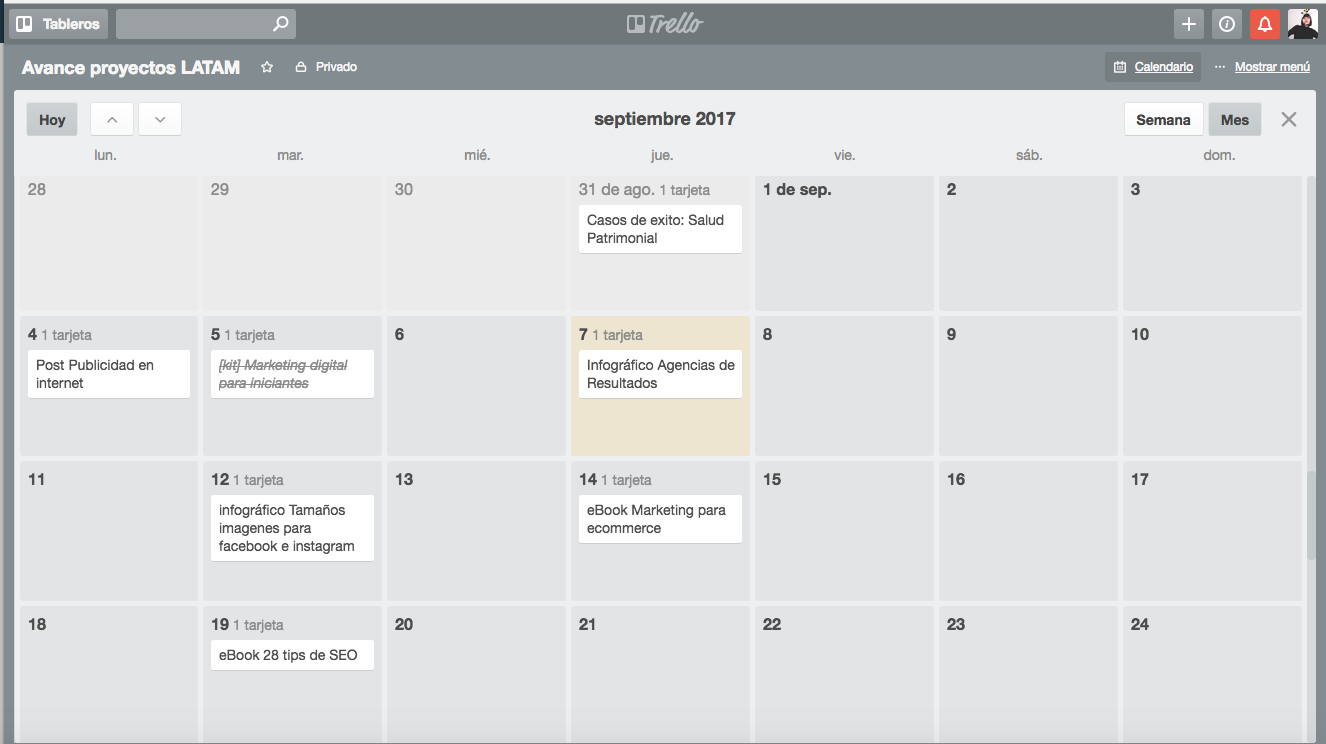
With this calendar, we can organize our launches, understand what day is ideal to launch an email, to which audience it will be segmented, and know how to optimize times and establish a layout production flow.
Our entire operation is optimized according to the calendar. This ensures the organization and assertiveness of our emails.
4. Segmentation
To send emails correctly to the right people, it is important that you analyze your audience and divide it into niches. This way, you can communicate in a segmented and correct way with each Lead.
Below, some examples of segmentation that can be used. This changes a lot from company to company, so we bring those that we see most frequently among different companies:
- Personas
- Managerial roles (decision-makers, more strategic materials) or technical roles (more practical materials that facilitate day-to-day work)
- Professionals in sales, HR, Marketing, etc.
- Area of operation of the Lead's company (Technology, e-commerce, Health, etc.)
- People who have already shown interest in other content on the same or similar/complementary topic.
- People who have, or have not, made a conversion in the last 4, 5, or 6 (or more) months (level of engagement with your company).
- People who have already shown interest in a certain product but did not buy.
- Customers, non-customers, people who negotiated but did not close a deal, etc.
- Buying stage
- Profile and Lead Scoring score
For segmentation to generate results in an email campaign, the union of three factors is necessary:
4.1. Information
Without information, there is no segmentation.
How can I send a campaign to Boca fans living in Córdoba, if I look at the Lead base and I don't know which team people support and I also don't know the province where they live?
That information in the base can come from many places. For those working with Digital Marketing, the most common is perhaps from Landing Pages.
It is very important, when creating a Landing Page, to define what questions will be asked, i.e., the most relevant information to request that will help your company make better segmentation.
4.2. Process
With the information in hand, the next step is to think about the process as a whole, not only to create campaigns, but for the launch itself.
It is quite common to see companies defining the offer before defining the audience. There is nothing wrong with that, but when we have information about the Lead base, it is a quick win – a rapid success – to make an offer specifically for a well-segmented audience.
For example: when making some segmentations, we see that we have many Leads from technology companies. We also see that we have never created material aimed at that segment. In that case, to achieve a quick and accurate win, we should create an eBook "Digital Marketing for technology companies".
4.3. Technology
The segmentation work can seem quite complicated and costly when using an unsuitable tool for it.
For example: there is a whole process to create a material, make a Landing Page, segment, create the campaign, and analyze.
If your company uses a different tool for each of these stages and those tools are not well integrated, a lot of information can, and will, be lost along the way.
That is why an "all-in-one" software has greater potential to generate results and improve the productivity of the marketing team.
Another important point that facilitates segmentation is using an Email Marketing tool that has dynamic lists, i.e., lists that update automatically according to what a Lead fills in on a Landing Page.
This is because the work of creating a segmented list before each email send is eliminated, leaving time to worry about strategy, not execution.
Important Elements That Compose an Email Marketing
Each Email Marketing campaign is composed of a series of elements. Each of these elements has its importance, so we recommend that you always pay close attention to all items.
Below, we will talk about each of them and state some good practices.
Sender
Do you feel important when you receive a communication directly from the address "contact@company.com"? We bet not. Personalization is key to a successful email strategy, so if you use "contact" to talk to your customers, you need to find alternatives.
The best practice in this regard is to use a personal sender, in the style "yourname@company.com". A survey indicates that 68% of people decide to open an email based on the sender. By creating an identity that reflects a feeling of trustworthiness, you increase your open rates.
Size
Obviously, to create empathy, your address must be readable, so it cannot be too long. This is even more important on mobile, as many devices limit the number of characters on the screen. If your company name is too long, try using abbreviations that make sense with the brand.
Some surveys indicate that the maximum number of characters in the sender is 23, but there is no unanimity on the subject. Just in case, keep an address short.
No reply? No
"I'm sending you this email, I want you to read it, convert, but I don't want to know what you think." It's strange, isn't it? This is what a company implies when it uses the sender "no-reply@company.com".
An equally wrong variant of no-reply is the message "do not reply to the email, if you want to get in touch, click on the link below". It is not practical and discourages the reader from conversing with your company.
Email Subject
The email subject is the first contact your Lead will have with your campaigns, and one of the main elements that will influence the opening – or not – of the email. Therefore, it is very important to consider 5 influencing factors in the subject line: generate interest (explain benefits + sharpen curiosity), show relevance, have good reputation (relevance - frustration), create a sense of urgency, and cause positive emotions.
To achieve this, you can follow some good practices in email subjects that stimulate opening. Some of them:
Focus on an objective
If you are interested in promoting a specific article or offer, indicate it clearly in the subject line. People will give more importance to that topic, making the objective easier to achieve.
Creating urgency can improve conversion
Some promotions like "only first 10 people" or "spots only until tomorrow", which create scarcity and urgency, can make people more willing to act effectively when receiving the email.
Avoid spam or overly commercial words
One type of anti-spam filter looks for similarities between your emails and those marked as spam. Therefore, try to avoid words that are commonly used by spam like Viagra, webcam, etc. The same goes for very commercial words: free, promotion, click, open, free, credit, offer, buy, see, check, etc. These words are heavily used in emails and the chances of generating frustration are high.
Do not try to convince the user to open the email
The subject should say what the email contains, do not sell what you already have. Some companies send emails like "Open and discover what's waiting for you". This type of call, amidst so much spam, is no longer very effective. The ideal is to clearly state what is inside the message. If what is inside interests the reader, they will open it.
Personalize the email subject
Personalization brings interest, relevance, reputation, and positive emotions, which are factors of a good subject line. You can segment by your Lead's name, or by some other characteristic of theirs related to your business.
Use supporting text (preheader)
The preheader is the first sentence to the right of the email subject. You have the possibility to include it in some email providers, such as Gmail, for example. Here at Evox, we have run tests that indicate that the preheader has a positive impact on open and click rates.
Keep the subject as short as possible
Long subjects are often cut off in mobile views and, furthermore, they do not stand out among the multitude of emails in the client's inbox. Therefore, keep the subject as short as possible. According to surveys, the ideal is between 20 and 41 characters.
Include numbers or percentages
Written numbers bring logical reasoning, which consequently demands more attention. Therefore, by using figures or percentages, you are inducing the user's focused attention. Use this suggestion when you can contextualize it with your subject.
Ask questions
Questions incite, and like numbers, require focused attention. Upon seeing a question mark, we are prompted to solve that problem. But be careful: do not answer the question posed at the beginning of the email. This generates rejection for commercial actions and ends up harming some factors, such as relevance and reputation. Let the reader discover the answers on their own. The experience will be much better.
Use emoji in the subject – occasionally
Emojis end up bringing an emotional and visual relationship to the email title, which aligns quite well with opening factors. It is important not to default to sending emojis, as it may lose relevance if done continuously. Use them with context and moderation.
Use keywords for your business
Include in the subject words that match your area of activity. Let's take the case of a fitness e-commerce, for example. Use: Lose fat, diet, fitness, muscle, supplements, etc. This will always create a context for the user and will end up maintaining good patterns of relevance, in addition to always reinforcing interest in your products/services.
Test
Create various different subjects, send them to yourself and evaluate how each message looks in the inbox. Use different ways of writing and sending to the list, verifying which has the best open rate. It is essential to always keep improving.
Email Body (or Text)
After creating expectation in your Lead and making them open the email with a catchy subject, it is time to focus on the email body. The idea is to be objective, write with a clear purpose, and get straight to the point.
Establish whether the email is about an opportunity, an offer, a discount, etc., and work your sentences thinking about this objective. The text should direct the reader to the Call-to-Action.
Call-to-Action (CTA)
Call-to-Action (CTA), literally translated, means "call to action" and that is the purpose of its use: to indicate to a person what the next step they should take in a given situation.
There are various actions we want to be performed, such as registering to receive a newsletter, filling out a form, downloading, requesting a quote, trying software for free, or accessing a link to a blog post.
The role of the Call-to-Action is to serve as a bridge to that action. It should reflect, in a single call, the value proposition of the offer in question.
There are countless shapes and versions a CTA can take, however, they all start from basically 3 components: buttons, banners, and text links.
Whichever type you choose for your email, there are some aspects that should be adopted to capture the Lead's attention and convince them to act, such as:
- Start with verbs and be specific. If you expect the visitor to perform an action, make it clear what it is. Also, indicate to the user exactly what the offer is about. For example, "download your eBook here" or "receive a quote by email".
- Use verbs in imperative mood ("do the download") or infinitive ("download"). The ideal is to test both options in different contexts to discover which works better.
- Create urgency. Words like "today" and "now" show how easy and immediate the action is.
- Use numbers to highlight benefits. It is interesting to make it as clear as possible for the user what they are doing and one way to better highlight the benefits of the action is to indicate them through numbers. "Get 30% off now" or "Buy today for only $15" are good examples.
- Offer something worth clicking: this is the most obvious, but often forgotten. Do not expect the user to perform the action just because that is what you want. They will only click if it is of interest to them. Therefore, it is important that the offer of the call is genuinely interesting.
- Use contrasting colors. If you want the user to look at a specific call, it must stand out to their eyes.
- The use of a color that contrasts with the other elements of the page can be a good way to ensure attention.
- Choose a good position. Place the call in a position that favors viewing. It is important to leave a visible call without the user having to scroll.
- Insert images. Images naturally attract more attention than words at first glance. If your call contains an image, it is very likely to be perceived.
- Indicate with arrows. Arrows have an almost unique power of implicitly saying "ignore everything else and look here, this is what matters".
Email List: Why Not to Buy a Lead Database
Buying email lists is among the supposedly easiest ways to start emailing in Digital Marketing, perhaps that is why it continues to be done despite not being a recommended practice.
"If everyone does it, I will too" or "it's such a large list that it's worth it, it's not possible that none of them have an interest in my business" are some of the justifications for this practice.
1. People do not know and show no interest in your company and your products
These people have no idea how your company got their emails. This creates a very negative impression when you start emailing.
Previously, the send had less negative impact for three reasons:
The first is that we did not have to deal with as much information as we do now (emails, messages, social media posts, etc.) and, in that sense, any unauthorized message is extremely uncomfortable, an unwelcome interruption that does not align with good Inbound Marketing practices. That alone makes the results disappointing.
The second reason is that we saw the explosion of Social Media, which gave voice and power to the consumer. Today, the company is looked down upon not only by the person who received the SPAM but also by all the friends that person has, if they use their profile to make a complaint.
The third is that email services are becoming smarter. There is a high probability that many users will mark your message as SPAM, and by doing so, the company's reputation is damaged.
Thus, future Email Marketing sends are likely to go straight to the SPAM folder, and so people who would have wanted to receive information from your company will not see your emails. It is impressive how even several large brands do not perceive this side effect.
2. Lists generally have very poor quality
The emails on a purchased list are usually the worst of all. People whose email addresses are on those lists are very likely to receive emails from many other companies that also bought lists.
In those cases, the chances of your email getting lost among so many others or being marked as SPAM are greater, as we already mentioned.
Additionally, these lists often have many emails that do not exist or have been deactivated. By including those emails in the contact list and sending, the email services available in the market already mark this as an "error" and interpret it as a clear sign that the list is not up to date or was built with low quality.
Result: your company goes into groups with a low reputation label, and for the following sends, the email service will use an infrastructure that is already "burned".
Likewise, the quality of the lists is generally poor in terms of the target audience as well. To "fatten up" the list and try to make it worth more, all sorts of emails are included, and profiles that have no relationship with your company's area end up entering.
3. No email marketing service with good reputation will authorize the send
We already talked about how anti-spam filters of email services work.
Based on what was discussed above, purchased lists represent very high rates of SPAM marking and delivery errors, which harms the reputation of the email server you are using.
Knowing that, this type of service always prohibits the importation of purchased lists, seeking to maintain a good reputation and high quality in their deliverability.
Therefore, good servers will not authorize the send, or in the case of bad servers, they will authorize your sends but surely they already have a bad reputation and thus will obtain a very low deliverability rate.
Note: Some people believe they can trick email marketing tools by claiming the list is their own and not purchased. The best email services have mechanisms to identify this: the email send is done in small batches, and with bad results, the campaign is interrupted.
4. Avoid buying lists and instead build your own for your company
It may be more laborious but it is worth investing in building your own contact base. Create incentives to capture emails from interested people and reap several benefits.
Extremely qualified list
All the people on the list you build are there because they know your company and gave permission to receive your emails. The results of opens and clicks tend to be considerably better in such cases.
Competitive barrier
This qualified list of contacts is a marketing asset that acts as a barrier for new competitors. They may try to copy the product or services you offer, but they will take a long time to have a contact list like yours (and therefore a relationship with so many potential customers).
Independence and economy
Your company gains more consistency and does not need to depend on purchasing lists to get results in email marketing. Independence is already good on its own, but it is even better when we remember it is free.
Email Marketing Checklist
There are several steps in sending an Email Marketing campaign that cannot be forgotten. The main ones are:
Planning
- Persona
- Segmentation
- Content
Calendar
- Define day and time of launch
Content
- Create an Outline
- Produce the email text
- Think of 5 different subjects (email title) and select 1
- Review
Email Layout
- Create the layout considering the content structure
- Review layout with final content
- Do a test send and check: -Email subject -Images -Links -Content
Launch
- Create segmentation according to planning
- Finish campaign configuration and schedule launch
Analysis
- Open rate
- Click rate
- Conversion rate
Email A/B Testing
Through A/B testing, it is possible to easily identify what needs to be modified in your Email Marketing strategy.
To conduct an email A/B test, select a sample from your contact list that will receive the email and send two different versions of the same message. It is interesting to test variables such as subject, body text, sender.
Currently, almost all Email Marketing tools have the A/B test option.
Once the A/B test is done, you can analyze metrics such as open rate, click rate, unsubscribe rate, most clicked links, and conversions.
Email Deliverability
Many believe that "delivering" an email means placing the message at the top of the Lead's inbox. But delivery in Email Marketing is much broader.
In general, when we send an Email Marketing, it leaves our send server and goes to the Lead's email server.
Upon reaching that server, a series of validations are made and many of the emails that are actually spam are stopped at this point (not to be confused with the spam folder we see in Gmail, for example). The Lead will never see these blocked emails.
Emails that are not blocked are delivered. These can fall either in the Lead's inbox or in the spam folder. Therefore, we must know that a delivered email is not necessarily in the inbox.
IP Reputation
In simple terms, the entire email campaign is sent through a server. Each server has its own IP, an address that identifies that server on the network.
This IP can be shared with several companies sending campaigns from the same IP, or dedicated, with one (or more) IP per company.
Every IP also has a reputation, a rating given to the IP based on its history and some other factors we will address later. The logic is simple: the higher the reputation, the better the delivery.
There are some services that monitor IPs. The best known is Senderscore, by Return Path.
To find out the IP your company is using, enter your domain in the Senderscore search, and it will show you the IPs your company is using.
Some factors that influence the reputation of an IP and consequently delivery are:
Hard and Soft Bounces
A bounce is a temporary (soft) or permanent (hard) error that occurs when trying to deliver an email to a recipient. If your company sends a campaign and there are many errors, it is a sign that the list quality is not good, and consequently, neither will the delivery.
Spam Complaints
If a recipient chooses not to receive your company's emails and yet receives them, they may proactively mark the email as spam. Such a complaint carries a lot of weight in reputation, and the more complaints, the worse the delivery.
Spam Traps
Spam traps are, in general, non-existent or inactive email accounts from email providers, such as Gmail, Hotmail, etc. – used to find spammers.
If you are caught in a trap by sending to one of these accounts, your delivery rates will be drastically affected, as email providers understand that your messages are unwanted – i.e., spam.
When an email provider realizes that you have sent an email to a spam trap, both your IP and domain risk being blocked – i.e., your messages no longer reach Leads using that provider.
Engagement
It is useless to deliver emails and have a good inbox placement if there is no engagement (opens, clicks, etc.). Although it is a metric that is harder to track due to privacy reasons by a service like Senderscore, email tools like Gmail take it into account when applying their own filters to define how this email will be delivered.
Blacklist
Some email servers, tired of so much spam, decided to track the IP of the server sending the messages and placed them on a "blacklist". Whenever an email comes from that server, it is immediately considered spam. The practice worked well and that list was shared with other servers. Today, the main providers use this list, and once you are on it, it is very hard to get off.
Our suggestion to overcome this barrier is to send Email Marketing only if you have permission. The only way to get out of a blacklist is to prove that you had opt-in to send the message. And to avoid getting on it, always follow good Email Marketing practices.
Whitelist
Whitelist consists of a set of emails, IPs, or domains that have good practices, without the need to be approved by anti-spam filters, and are delivered directly to the user's inbox.
How to get on a whitelist
The main prerequisite to get on a whitelist is to follow good email sending practices, such as those presented on this page. The most important of these is the use of opt-ins to build your base.
These will ensure you have good delivery rates and therefore be accepted by a large number of servers.
You need to make a request to get on a whitelist. The best known are from Return Path and DNSWL. Both organizations will evaluate your practices and, at the end of the tests, may or may not grant a certification.
And if, by chance, you are on one of the most renowned blacklists on the market, do not even try to apply, your company will not be approved. Furthermore, entry is not perpetual: if you leave good practices aside, the certification will be canceled.
Authentication and Security
Due to the large number of emails used for fraud and illegal activities, such as fake bank emails, there are a series of security mechanisms to ensure the authenticity of emails.
Emails that are not properly authenticated may be moved to secondary inboxes or spam and even rejected by servers. Therefore, it is important to ensure the configuration indicated below.
SPF
SPF (Sender Policy Framework) is an authorization for an email tool to send messages using your domain. It is one of the best known and oldest authentication methods, configured through a DNS record. In this case, the email with your domain is sent through the tool's domain email.
DKIM
DKIM (DomainKeys Identified Mail) checks whether the sent message has not been changed mid-route, ensuring the consistency and authenticity of the content. If it identifies any DKIM inconsistency, the email will not be delivered. Like SPF, it is configured through a DNS record.
DMARC
To configure DMARC (Domain-based Message Authentication, Reporting and Conformance), SPF and DKIM must be correctly configured, as the configuration states what should happen to emails that fail those other two checks. You can set up an email address to receive a report with the issues for correction.
Whitelabel
Like SPF, Whitelabel allows the sending tool to send emails using your domain, but the difference is that the email is actually sent as if it were sent by the company, without appearing to have been sent through the tool. Currently, it is the default configuration used by the main email tools on the market.
Sender ID
Sender ID is a method developed by Microsoft that is used in its email services (Hotmail and Outlook), very similar to SPF. Not having this configuration can harm email delivery, especially for lists with many addresses of this type.
Reverse DNS
Reverse DNS is a check frequently used by email servers to confirm the sender's identity, verifying which domain responds for the IP used in sending.
Feedback Loop
Feedback Loop is basically a spam marking notification, indicating who made it, to take the necessary measures to ensure that user does not receive messages again. Some tools already manage this functionality, eliminating any extra work, but not all email sending tools provide this information, which can harm reputation and campaigns.
It is important to set up an abuse@ email, which is the default email used by email servers (and even users) to send a complaint or notification of problems. After creating the email, it must be configured on the site http://abuse.net.
WHOIS
WHOIS is the online record of who owns a domain on the internet. Some email servers use the information present in WHOIS to verify the authenticity and truthfulness of the sender, influencing deliverability.
Email Marketing Metrics
After launching an email campaign, the tool used for sending starts to generate a report, presenting performance metrics. Following and understanding these data is essential to determine if the campaign result was satisfactory, to generate learning and improvements for future launches.
Positive or negative performance of email campaigns also directly influences future campaigns, as Internet Service Providers (ISPs) analyze the reputation of the sending server.
In addition to serving as a report and influencing the performance of future campaigns, the generated data also make it possible to perform and measure tests, such as changing the day and time of the launch, the subject, or the content, for example, and following the impact generated on metrics.
Another point of attention is to follow the market average and ensure campaigns that are at least within the average. The metrics presented below also bring the general market average, but these values can vary according to the company's segment.
Positive Metrics
These are metrics that result both from good practices when developing and sending the campaign and from positive actions of the Lead who received the email, such as opens and clicks, with the ideal being above average. Check the main positive metrics and how to maximize your numbers:
Delivered Emails
It is the number of recipients who received the email and the percentage in relation to the total emails sent. Emails that are not delivered are generally bounces (hard or soft). A considered good delivered email rate is 95% or higher.
There are two main reasons for an email not to be delivered: some type of authentication error or because the recipient's address has a problem.
Some email sending tools may block the sending of emails if the delivery rate remains low during the launch, to try to preserve the reputation of the sending server.
To maintain a high email delivery rate, it is important not to buy email lists, manually register emails, or send to old contact lists. Sending messages to more segmented lists can also positively affect the delivery rate.
Open Rate
The open rate of an email campaign is the percentage of contacts who opened the email, considering the number of contacts who received it.
To calculate the open rate, you need to divide the number of opened emails by the total number of delivered emails, multiplying the result by 100 (to get a percentage), but practically all tools already display the metric directly in the results report.
In general, a considered good open rate is at least 15%, but this percentage can vary according to the segment and the type of email sent. To evaluate the average of your sector, check the Email Benchmarking tool mentioned above.
Several factors can affect the email open rate, such as landing directly in the user's inbox and not in filters like "Promotions", "Updates", or even the spam folder. To prevent your message from being filtered, the ideal is to follow good email marketing practices, also present in this article.
Additionally, be careful in developing the subject, avoiding the use of words that can classify the email as spam, and inciting user curiosity generates a great impact on the open rate.
Click Rate
The click rate is the percentage of contacts who clicked on the email, also in relation to the total emails delivered. Its calculation is similar to the email open rate, simply divide the number of clicked emails by the number of delivered emails, multiplying the result by 100.
A considered good click rate should be above 2%, on average. Again, the recommendation is to use the Email Benchmarking tool to compare with the average of your segment.
Some tools present the CTR (click-through rate), which instead of calculating the emails that were clicked in relation to the total emails delivered, calculates in relation to the total emails opened, presenting a much higher percentage. The problem is that not always a high CTR is synonymous with a successful campaign, as this calculation often inflates the results.
To ensure a click rate above average, it is important to include external links through Calls-to-Action, so that the user is interested in accessing the content.
Conversions
What good is a campaign with high open and click rates, if in the end you don't know if it added to your Digital Marketing strategy? That is why it is important to measure the results of the email in conversions.
Here, it is necessary to evaluate according to the campaign objective. They can be new Lead conversions, Leads converted to qualified Leads, opportunities or customers, and even sales in general or of a certain product or service.
In addition to the possibility of seeing these results in the reports of the email sending tool, you can also track them in your e-commerce platform (if applicable) or even in Google Analytics.
The main email launching tools include markings on the links present in the email, which makes the URL trackable and allows isolated analysis of the channel's performance within Google Analytics itself.
It is also important to measure the conversion rate of emails in conversions. If this rate is low, it is a sign that it is necessary to optimize the conversion of the page or use a Landing Page, if you are not already using one.
Negative Metrics
Negative metrics occur mainly due to low quality or lack of planning of campaigns. They are inflated due to sending unwanted messages, outdated or purchased contact lists, emails with little text, and other bad practices mentioned in this article. Check the main negative metrics and how to keep your values at a minimum.
Bounce Rate
Bounce rate is the percentage of emails that were rejected by the recipient's server compared to the total number of email messages sent. There are 2 types of bounces: soft bounce and hard bounce.
- Soft bounce: Occurs when the message is not delivered due to a temporary reason, such as the recipient's mailbox or email server having issues or even being offline. The ideal is to try to keep this rate below 5%.
- Hard bounce: Occurs when the message cannot be delivered for permanent reasons, such as non-existent email or server blocking. The ideal is to try to keep it at a maximum of 3%.
Since this metric directly interferes with the number of delivered emails, it is important to keep the rates always below the indicated levels, so as not to affect the delivery of future emails or even risk having email sending blocked.
In addition to following good practices in email production and list segmentation, maintaining an email calendar with a good campaign frequency directly influences this metric, because when sends occur at long intervals, many emails on the list have already ceased to exist in that period.
Spam Marking
Spam marking is done by the user who received the email, manually indicating that the received email is spam. This is a very delicate metric and can greatly harm reputation, so when evaluating this metric, your campaign cannot have more than 0.1% spam rate.
It is important that you stop sending email messages to all contacts who marked the spam as soon as possible to avoid serious delivery problems.
To prevent the user from marking your message as spam, it is important to follow good email marketing practices, such as not buying email lists, keeping the base always updated and clean, and avoiding launching campaigns to the entire contact list.
Unsubscribes
The unsubscribe rate represents the people who received the email and who clicked on the unsubscribe link to not receive new email messages from the sender. It is important to keep campaigns with a maximum of 1% unsubscribe rate.
Between spam marking and unsubscribes, it is preferable that the contact unsubscribes from the list, as the impact on email delivery is smaller. That is why it is very important that all emails include the unsubscribe option for the user.
When the user unsubscribes from a list, the email sending tool automatically removes their email permanently from future sends, without needing to search for the user in the list to manually extract them.
This metric ends up revealing that there are problems in the email calendar or in the quality of what is sent. An increase in email unsubscribes is a warning that the company needs to reformulate its entire strategy and try to reverse the situation.
Glossary of Terms
Above the Fold
It is the first view we have of the email, usually the first 600px height of an email for web and 300px for mobile devices. Above the fold is the first visible part without the need to scroll down. For Email Marketing professionals, it is the most important area of the email.
Alert
It is an email with the objective of notifying recipients of an event or special price.
ALT (Alternative Text)
It is the text used to describe an image. Inserted in the HTML of the email, it is used in defensive design so that, when an image does not load, the person opening the email can know what the content is about.
Attachment
A file that accompanies an email but is not contained in its message. It is not recommended to send attachments in newsletters, as many servers do not allow them. This is because it is a practice widely used in SPAM messages.
API (Application Programming Interface)
An information integration that allows software to send data or information between themselves. In Email Marketing, it is widely used to segment and personalize.
Subject
It is the title of the email that will be shown in the recipients' inbox. It is one of the main parts of an email and must be produced with detailed attention, as it can influence the open and conversion rate.
Authentication
It is a term used in email deliverability. It involves automatically verifying the authenticity of who is sending an email for certain providers. It is done through various forms, mainly: DMARC, Domain keys, DKIM, and SPF.
Autoresponder
It is the most basic form of email automation. It basically sends a series of pre-programmed emails automatically according to a determined trigger (action or behavior of a Lead).
Behavioral Targeting
In Email Marketing, behavioral targeting is a concept that translates into sending campaigns based on users' actions and behaviors on your website. The possibilities are diverse: from openings of a certain email to navigation on a certain product.
Blacklist
It is a list of domains classified as spam or suspicious. It is the most feared term by Email Marketing professionals, as it harms deliverability and consequently open and conversion rates. Blacklists are frequently consulted by providers to reject emails before they reach the recipient.
Block
When a provider blocks the receipt of emails. Many providers block email addresses or domains that are reported for sending spam or being on the blacklist.
Bounce
Emails that are returned due to some error, thus not delivered to the recipient. There are two types of bounce: soft, for temporary errors like a full inbox, and hard, for permanent errors like a non-existent email address.
Bounce Rate
For Email Marketing, it is a metric to measure the percentage of how many emails are bounced divided by the number of emails sent. It is widely used to measure the "health" of a list, i.e., what is the potential relationship with that base.
B2B (Business to Business)
Term used for companies whose clients are legal entities.
B2C (Business to Customer)
Term used for companies whose clients are natural persons.
CAN-SPAM
United States legislation that regulates Email Marketing for commercial purposes. Established in 2003. It stands for Controlling the Assault of Non-Solicited Pornography And Marketing Act. It was created due to various spam complaints in the country. It is used as a basis in some countries for regulation.
Call to Action (CTA)
In an email, it is the link, image, or button placed to make the user take an action.
Campaign
It is the composition of an email with a specific objective, for example sales, relationship, or updates.
CGI (Common Gateway Interface)
It is a method used to integrate a WWW server with other programs executed on the system. It is widely used in processing registration or contact forms to ensure information reaches the ESP.
Clickthrough
Clickthrough is the action of a recipient clicking on a link included in the email.
Clickthrough Rate (CTR)
It is the metric used to analyze the click rate of an email. It consists of dividing the number of clicks by the number of emails sent. It is important to always obtain the number of unique clicks, because it is possible for users to click more than once on your email. This way, there is a better measure of your campaign performance.
Click to Open (CTO)
Metric used to analyze the effectiveness of a layout, template, or email text. It is the number of clicks divided by the number of opens.
CPA (Cost per Acquisition)
It is the cost to generate a Lead, newsletter subscribe, or customer in a single email campaign. In summary, it is the total cost of an email campaign (in money) divided by the number of Leads, subscriptions, or customers produced.
CPC (Cost per Click)
It is the metric to analyze the cost of obtaining a click on the sent email. It is the total value of the campaign expense divided by the number of clicks.
CPM (Cost per Thousand)
In Email Marketing, CPM means the cost of sending 1,000 emails. It is the most used metric to calculate the price in ESPs.
Conversion
When a user performs a desired action on the sent email. Conversion is used to measure the success of an email and can be interpreted in various ways (material downloads, purchase, registration in a form, etc.).
Co-registration
It consists of sending offers from a partner company to your email base or vice versa. It must be done carefully and in accordance with the privacy policies offered to the user at the time of registration.
CRM (Customer Relationship Management)
In the context of Email Marketing, CRMs are the software used to manage Lead and customer information, performing segmentation, automation, and analysis.
Cross-sell
Term used to define the concept of applying cross-selling. For example, it is widely used in e-commerce to analyze a customer's purchase and offer complementary products.
CSS (Cascading Style Sheets)
It is a system of codes used to alter visual characteristics of HTML. In Email Marketing, it must be used with caution because many ISPs avoid reading most CSS styles. Therefore, CSS must be inserted within the HTML code itself, in a way we call inline.
Deploy
It is the act of sending an email campaign after performing the necessary tests.
Unsubscribe
Act of removing an email address from an email list, requested by the recipient. For good practices, in commercial emails it is recommended that there is always an unsubscribe button included in the email.
DKIM (DomainKeys Identified Mail)
It is a message signing system with key encryption used to validate the authenticity of an email.
DMARC (Domain-based Message Authentication, Reporting and Conformance)
Authentication protocol designed to reduce phishing and email fraud. It is used by most major email providers, such as Microsoft, Yahoo, and Google.
DNS (Domain Name System)
For each internet access, an IP (Internet Protocol) address is established. DNS is a kind of database that stores an address to that IP, thus allowing to name the domain.
Reverse DNS (rDNS)
Process in which an IP address is correctly validated using a domain. It is a method used to capture invalid IP addresses used by spammers. For example, if a spam filter or program does not find the IP and domain data, it may reject the email.
DomainKeys
Old authentication method developed by Yahoo used to verify the DNS domain and message integrity. Several aspects of this method were used for the composition of DKIM.
Double Opt-in
Process in which the user registers to explicitly confirm that they wish to receive offers from a certain sender. It is a method used to ensure the quality of email lists and is considered a good deliverability practice. It is done in two stages:
- User registration.
- Registration confirmation by email.
Dynamic Content
Dynamic Content is email content that changes with the use of variables according to the interests, rules, or preferences collected at the time of a user's registration. Dynamic content can reflect from past purchases and current interests to abandoned purchases.
Email Client
Software used by users to read emails, also called ESPs. Among the main ones are Outlook, Gmail, and Yahoo.
Delivered Emails
Number of emails sent minus the number of bounces. It is an inexact number, since not all ISPs report which emails enter or not, but on average it is valid to analyze if your email list is growing.
Email Service Provider (ESP)
Companies that provide Email Marketing sending services.
Transactional Email
Email sent to demonstrate a transaction, such as a download or purchase.
Deliverability
It can be seen under two interpretations: metric or concept. As a metric, it is the number of emails delivered to the user's inbox divided by the number of emails sent. Its measurement is complex as there are no tools that show the number of emails delivered to the inbox, but they can be estimated together with other engagement metrics like CTR. As a concept, we understand it as a set of strategies aimed at applying good market practices to improve the reputation of the domain and IPs towards providers.
Feedback Loop
It is a program offered by ISPs to inform email senders when emails have been moved to the trash or marked as Spam. Thus, the sender can understand which campaigns are generating complaints and remove users who are complaining and make improvements.
Firewall
A program or chain of programs designed to prevent unauthorized users or messages from accessing a private network. The firewall generally has rules or protocols that authorize or prohibit external users and/or messages. In the context of Email, a Firewall can be configured so that messages from certain domains or lists of users classified as spam are not delivered.
Hard Bounce
Message sent to an invalid, canceled, or non-existent email address. It is when there is a permanent bounce of the send. For good practices, it is recommended that after a hard bounce, an email should never be sent to that email address again.
HTML (Hyper Text Markup Language)
It is a markup language used to build web pages that can also be used in emails.
Inbound Marketing
Using a free translation, we can define Inbound Marketing as Attraction Marketing. The idea behind Inbound is that instead of having a company chasing customers using traditional Marketing techniques, it is making customers voluntarily find the company through search engines, referral sites, social media, etc. Email Marketing acts in Inbound mainly in the relationship (nurturing) stage of customers.
IMAP (Internet Message Access Protocol)
Standard protocol for accessing an email from a certain server. Typically, the standards used are POP or IMAP.
IP (Internet Protocol)
A unique number determined for each device connected to the internet. An IP address can be dynamic, i.e., it can change each time a campaign is launched, or it can be static, which does not change. Static IPs are better because dynamic ones often fall into spam filters.
ISP (Internet Service Provider)
Companies that offer access to internet services. In email, they are companies that offer access to email tools, such as Google, Microsoft, and Yahoo, for example.
KPI (Key Performance Indicator)
They are the key performance indicators analyzed in an email, i.e., the fundamental quantitative values that measure the main results of a campaign. They are comprised of the main metrics: CTR (Click-through Rate), Conversion, and Open Rate.
Landing Page
Destination page after clicking on an email.
Layout
It is the visual part of a campaign or page.
Lead
Person who leaves their data in a conversion form and shows interest in your company, product, or market topic. It can be considered a potential customer.
Database Cleaning
Process that consists of removing invalid emails (hard bounces), problematic emails (soft bounces), and unsubscribes from the user list. It is a widely used method to improve deliverability.
Email List, Mailing List, or Database
List of captured email addresses to which emails are sent. It can be a proprietary list or a third-party list, sent with consent.
Suppression List
List of emails to which you cannot send messages under any circumstances, as they can harm your deliverability. Among them are hard bounce emails and unsubscribes. In some email sending software, by default, lists are created automatically, without the need to manage them.
Multi-part MIME (Alternative)
Messages that contain versions in both HTML and plain text. It is used when it is not possible to render in HTML, the message can be read in text. It is considered a good deliverability practice by ISPs.
Newsletter
The process of sending the same email to all subscribers of a list, without personalization or segmentation. It is a periodic email focused on information, news, and updates.
Opt-in
When a user requests their email address to be registered on a specific list.
Opt-out
The opposite of opt-in, it is a user's request to have their email address removed from a specific mailing list, making it mandatory for the company to remove the email address from its send base.
Outbound Marketing
Outbound Marketing, or Traditional Marketing, has as its main objective to offer services or products to customers. The idea is to actively go after the customer and not necessarily generate a genuine interest from that potential customer in your company.
Persona
Persona is a representation of an ideal customer. To create a persona, real data about the behavior and demographic characteristics of your customers should be considered. In Email Marketing, the persona is used for segmentation, personalization, content production, and campaign targeting.
Personalization
It is a segmentation method where each email is different for each Lead. One of the best examples is when each Lead's name is personalized in the email. Today, there are various possibilities for personalization, from a person's taste for certain products to the pages they have browsed, thus achieving an assertive email at the exact moment of that Lead's purchase.
Phishing
It is a form of identity theft in which the sender seeks to steal personal data from the recipient, such as bank details, identity, among others, through email.
Footer
It is the final area of an email or newsletter message that contains information that does not change from one edition to another, such as the company's address, the user's email, the link to unsubscribe, etc. Some software already automatically inserts the footer with the desired information.
Plain Text
It is the email produced solely in text, without the need to insert HTML code.
Privacy Policy
A clear and transparent description of how a company will use the email addresses and other information captured by opt-in in an email base. If, for example, you sell email lists, send emails to opt-out leads (not suggested practice), that should be in your privacy policy.
POP (Post Office Protocol)
Protocol that an email client uses to send or receive messages from an email server. Usually, POP or IMAP are used.
Reputation
As the title says, it means how acceptable the emails sent are on average. Reputation can be measured in various ways, but the main one is using Sender Score, where there is a momentary analysis of the domain's delivery capacity.
Responsive Design
It is widely used due to the need to communicate through different devices (tablets, cell phones, watches, computers, etc.). It is a layout that modifies according to the size of the device on which it is being read, optimizing the user experience.
ROI (Return on Investment)
It means the profit for every $1.00 invested. It is used to measure the profit obtained through email campaigns.
Segmentation
It is the action of sending a specific email to a selected group, in a more assertive way in communication with that group. It is a highly recommended practice, as it improves the user experience and tends to deliver better results, as well as improve delivery capacity.
Sender Policy Framework (SPF)
Protocol used by ISPs to verify that the origin of the email is validated by the sender. It is basically a set of rules to combat email forgery (phishing).
Dedicated Server
An email server used by only one sender. A dedicated server usually costs more because it is not shared, but it performs much better (if sending practices are correct). Generally, emails are sent faster, the server is more secure, and the chances of a second send entering a blacklist due to spam are lower.
SMTP (Simple Mail Transfer Protocol)
Simple protocol for email transfer. It is the protocol used for message transfer between servers.
Soft Bounce
Email sent to an active list but returned after being sent. It is a temporary problem (the server is not online, the inbox is full, etc.). The email should be retained until it can be delivered. 5 attempts are recommended, after which the email can be considered a hard bounce and harm your deliverability.
SPAM (Sending and Posting Advertisement in Mass)
It is the delivery of unauthorized emails by certain domains. It is the worst practice in Email Marketing and should be avoided as much as possible, because it can cause your domain to enter eventual blacklists.
Spamtrap
Tools used by email providers and blacklists to identify senders of unwanted messages (SPAM). A practice used by spamtraps is non-interaction with received emails, analyzing whether the sender sends emails to people who do not open or click on their emails.
Subscribe
It is the process of registering or subscribing to a specific email list through a command. It is an opt-in.
Open Rate
It is a metric used to analyze your email's open rates. It is the total number of opens divided by the number of emails sent. The open rate is considered a key metric as it demonstrates the participation of Leads in your campaigns, as well as indicating whether the subject had good performance.
Conversion Rate
Conversion is a metric used to measure the success of an email and can be interpreted in various ways (download an eBook, purchase, registration in a form, etc.). It is the number of conversions divided by the number of emails sent.
Template
Document in HTML with a defined and standard layout, i.e., it can be used in different emails changing only its content. It is a way used to speed up email production.
A/B Test
It refers to a test situation in which a list is divided into two equal parts, so that you can test whether a new element shows improvement over the old one or not. This term is used both in Email Marketing and other fronts.
URL (Uniform Resource Locator)
It is the web address for a page, always starts with http:// (or https:// for a page with security protocol), followed by www. (or variations) and the domain name.
Whitelist
A set of emails, IPs, or domains previously approved, i.e., without the need to be authorized by anti-spam filters. They are delivered directly to the recipient's inbox.
Workflow
Workflow, literally translated. It is the entire organization and synchronization of processes with a common end goal.